

What Is AI and How Does It Learn Like Humans

A phone can turn spoken words into text, a car can detect a pedestrian, and a chatbot can answer a question in plain language. None of these tools “understand” the world the way a person does, yet each can perform tasks that once seemed to require human judgment.
That is the central idea behind artificial intelligence, often shortened to AI. It is a field of computer science focused on building computer systems that can do work usually linked with human thinking, such as recognizing patterns, learning from examples, making predictions, and solving problems.
The phrase can feel broad because it is. It covers simple tools that sort messages, advanced systems that read medical images, and language tools that generate text. What ties them together is not magic or emotion. It is data, math, and carefully designed methods that let computers find useful patterns.
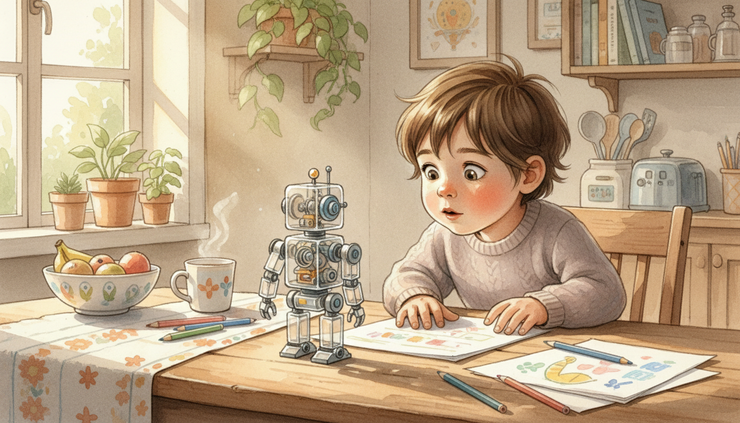
What artificial intelligence means in computer science
Artificial intelligence is a branch of computer science that studies how to make computers perform tasks that need intelligence when people do them. Those tasks may include:
Understanding language
Recognizing images or sounds
Planning a route
Sorting information
Making decisions based on evidence
Learning from past examples
Computer science is the study of how computers store, process, and use information. AI became one of its most important areas because it asks a big question: Can a machine use information in a way that looks intelligent?
That question is not new. In 1950, mathematician Alan Turing published a famous paper that asked whether machines could think. A few years later, researchers began using the term “artificial intelligence” for this field of study. Since then, the field has moved through many stages, from early rule-based programs to today’s systems that learn from very large collections of examples.
The importance of AI in computer science comes from its reach. Traditional software follows instructions written by people. A tax calculator, for example, can follow a fixed formula. A calendar app can alert someone at a set time. These tools can be useful, but they do not learn much from experience.
AI systems are different because they can improve at a task by learning patterns in data. That makes them useful for problems where the rules are hard to write by hand.
Consider handwriting recognition. A person can read messy handwriting by using context, memory, and experience. Writing a fixed rule for every possible handwritten letter would be nearly impossible. People write the letter “a” in many different ways. Some write it round. Some write it narrow. Some connect it to nearby letters.
An AI system can study many examples of handwritten letters and learn which shapes often match which letters. It does not need someone to list every possible version. It learns from examples.
That shift from fixed rules to learned patterns is one of the reasons AI became so important.
How AI mimics human learning without becoming human
AI is often described as “learning like humans,” but that phrase needs care. A person learns with a body, memory, feelings, social experience, and awareness. A computer does not.
Still, AI can mimic some parts of human thinking in a limited way. It can improve with practice, compare choices, spot relationships, and solve certain problems.
Learning from repeated examples
A child learns to identify a dog after seeing many dogs. Some are large, some small. Some have long hair, some short hair. Over time, the child notices common features. Four legs, a certain face shape, a way of moving, and sounds all help form the idea of “dog.”
An AI system can do something similar with data. If it studies thousands of labeled animal photos, it can learn patterns linked with dogs, cats, birds, and other animals. It does not know what a dog feels like, and it does not care about dogs. It only learns statistical relationships between image patterns and labels.
That sounds less impressive than human learning, but it is powerful. Given enough good examples, the system can often identify a new dog photo it has never seen before.
Solving problems by comparing possible answers
People solve many problems by testing options. If a route is blocked, a person looks for another road. If a recipe is missing one ingredient, a cook may choose a substitute. If a chess player studies a board, they look ahead and compare possible moves.
AI systems can use similar problem-solving methods. A navigation tool compares roads, travel times, and traffic patterns. A game-playing system compares possible moves and likely outcomes. A chatbot predicts which words are likely to answer a question based on patterns learned from text.
The system does not “reason” in the full human sense. It does not have goals of its own unless people design a task for it. It processes input, calculates likely outcomes, and produces output.
Recognizing patterns faster than people can
Humans are excellent pattern finders, but we have limits. A person can read one article at a time. A computer can scan huge collections of text, images, or numbers far faster. That speed helps AI find patterns that would be hard for a person to notice.
For example, a weather system can compare current conditions with many past weather records. A fraud detection system can compare a payment with past spending patterns. A voice tool can compare sound waves with known speech patterns to guess which words someone said.
These tasks rely on pattern recognition, not human-like awareness.

AI learns from examples instead of fixed rules
To understand modern AI, it helps to compare two ways of building software.
The first way is rule-based programming. A person writes exact instructions.
For example:
If the temperature is below 32 degrees Fahrenheit, mark it as freezing.
If a password has fewer than eight characters, reject it.
If a message contains a certain blocked word, flag it.
Rules work well when the task is clear. Computers are very good at following exact instructions. The problem comes when the world gets messy.
Language is messy. Images are messy. Human behavior is messy. A person might say, “I’m freezing,” even when the temperature is 55 degrees. A photo might show a cat partly hidden behind a box. A customer might ask the same question in 20 different ways.
Writing fixed rules for every possible situation becomes impossible.
That is where example-based learning helps.
What data pattern recognition means
Data pattern recognition means finding repeated signals in information. The “data” could be text, numbers, images, audio, video, or sensor readings.
A system might look for patterns such as:
Words that often appear in support questions
Shapes that often appear in road signs
Sounds that often match spoken commands
Number changes that often suggest a machine needs repair
Shopping behavior that often connects with a product category
The system learns by comparing examples. If it studies many photos labeled “stop sign,” it may learn that stop signs are often red, eight-sided, and contain certain letter shapes. If it studies spoken examples of the word “hello,” it may learn the sound patterns that usually match that word, even when people speak with different accents.
This process is not the same as memorizing every example. A useful system generalizes. That means it learns enough from past examples to make a reasonable guess about a new example.
Training, testing, and feedback
A common way to build an AI model follows a simple pattern:
Collect examples
The system needs data related to the task. For a voice tool, that may be audio clips and written words. For image recognition, that may be photos and labels.
Train the system
The computer studies the examples and adjusts its internal settings to make better predictions.
Test the system
The system tries examples it has not seen before. This shows whether it learned useful patterns or only memorized the training examples.
Improve the system
Engineers compare wrong answers with right answers, then improve the data, the method, or both.
This is similar to studying for a test. If someone memorizes only five sample questions, they may fail on a new question. If they understand the pattern behind the questions, they can answer new ones. AI models face a similar challenge.
The quality of examples matters. If the data is incomplete, confusing, or biased, the system can learn the wrong patterns. For example, if an image system only sees dogs photographed outdoors, it may struggle with dogs inside a house. If a language system learns from text with errors, it can repeat or reflect those errors.
That is why responsible development matters. Good AI work includes careful data selection, testing, updates, and human review.
Why AI can seem smart even though it has no feelings
AI can write a friendly reply, answer a question, or speak in a calm voice. This can make it seem emotional or self-aware. It is not.
An AI system does not feel joy, fear, pride, guilt, or curiosity. It does not wake up with plans. It does not understand its own existence. It does not have personal memories unless people design a system to store past interactions, and even then, that storage is data, not lived experience.
This point matters because people naturally assign human traits to things that use language. If a chatbot says, “I’m happy to help,” it sounds like a feeling. In reality, the phrase is a pattern of words selected because it fits the situation.
Processing is not awareness
A calculator can produce the answer to 25 times 4. It does not understand multiplication the way a student might. It follows a process.
AI systems are more complex than calculators, but the core idea remains. They process input and produce output. The input might be a question, a photo, a voice command, or a set of numbers. The output might be an answer, a label, a prediction, or a recommendation.
The system may produce impressive results, but it is still working with data. It does not know meaning in the full human sense.
Language can create an illusion of personality
Language tools can be especially convincing because conversation is closely tied to identity. When people hear fluent sentences, they often assume there is a mind behind them.
A chatbot may explain a science topic, summarize a document, or help draft an email. It may also sound polite or confident. The confidence can be misleading. If the system predicts text that sounds right but is false, it can present an error smoothly.
That is why AI output should be checked, especially for high-stakes topics such as health, law, education, safety, or finances. The system can be useful without being trustworthy in every situation.
A practical rule helps: treat AI as a tool that can assist with information processing, not as a person with judgment, emotions, or responsibility.

Common AI concepts explained in plain language
AI includes many methods, but a few core ideas show up often. Understanding these AI concepts makes the subject less confusing.
Term | Plain meaning | Simple example |
Data | Information the system studies | Photos, text, sounds, or numbers |
Model | The learned pattern system | A tool that can identify a bird in a new photo |
Training | The process of learning from examples | Studying labeled photos of birds and cats |
Prediction | The system’s best guess | Guessing the next word in a sentence |
Error | A wrong or weak result | Labeling a cat as a dog |
Feedback | Information used to improve | Showing the correct label after a mistake |
These terms matter because they keep the conversation grounded. AI is not a single machine or one type of app. It is a broad field built around systems that learn patterns and use those patterns to act or respond.
Practical uses of AI in everyday life
AI is already part of daily life, often in ways that feel ordinary. The most common uses do not look like science fiction. They look like search tools, message filters, voice controls, and recommendation systems.
Chatbots that answer questions
Chatbots are one of the clearest examples of AI applications. A chatbot can receive a written question and generate a written answer. Some help with basic customer service. Others help people practice language skills, summarize information, or brainstorm ideas.
For example, a person might type, “How do I reset my password?” A simple rule-based bot might look for the exact words “reset password.” A more advanced system can understand related wording, such as “I can’t get into my account” or “I forgot my login.”
The useful part is flexibility. People rarely ask questions in the same way. AI helps the system handle many versions of the same request.
Still, a chatbot has limits. It may misunderstand context. It may give an answer that sounds correct but misses the real issue. For important tasks, people should have a clear way to confirm information or reach a human.
Voice tools that turn speech into action
Voice tools use AI to connect sound with meaning. When someone asks a device to set a timer, play music from a local file, or send a message, the system first has to turn speech into text or commands.
This requires pattern recognition. People speak at different speeds, with different accents, background noise, and word choices. A voice tool compares sound patterns with learned examples of speech. Then it picks the most likely words and action.
The process may feel instant, but several steps happen quickly:
Capture the sound
Separate speech from noise
Match sounds to likely words
Interpret the request
Complete the task or ask for clarification
Voice tools work best when the request is clear and the task is narrow. “Set a timer for 10 minutes” is easier than a vague request like “help me plan my day.”
Image recognition in cameras and safety tools
AI can help systems identify objects in images. Cameras may detect faces to focus a picture. Safety tools may detect pedestrians, lanes, or obstacles. Medical software may help trained professionals review scans, though human judgment remains vital in care decisions.
Image recognition depends on examples. A system learns what certain objects tend to look like under many conditions. Lighting, angle, distance, and background all change the image. Training examples help the system handle that variety.
Filters and sorting tools
AI can also sort information. Email filters can identify unwanted messages. Streaming systems can group content by viewing patterns. Search tools can rank results based on relevance.
These uses may seem simple, but they save time because they reduce large amounts of information into a smaller set of likely matches.
The risk is that sorting systems can also hide information, repeat past patterns, or make unfair mistakes. This is another reason humans need to test and monitor systems carefully.
How AI differs from traditional software
Traditional software and AI software can work together, but they are not the same.
Traditional software | AI software |
Follows rules written directly by people | Learns patterns from examples |
Works best when the task is predictable | Helps when the task has many variations |
Gives the same output for the same rule and input | May change as the model or data changes |
Easier to explain step by step | Can be harder to explain in detail |
Example: calculate sales tax | Example: recognize speech in a noisy room |
A simple thermostat can follow a rule: if the room is below a set temperature, turn on the heat. An AI-based system might study patterns in temperature, time of day, occupancy, and past adjustments to predict when heat will be needed.
The traditional rule is clearer. The AI approach may be more flexible. The right choice depends on the task.
Not every problem needs AI. If a fixed rule solves the problem well, a simpler program may be better. AI is most useful when the task involves messy patterns, large data, or many possible variations.

Why data quality shapes AI results
AI learns from examples, so the examples matter. Poor data leads to poor results.
This idea is easy to see with a music student. If a student practices from a song sheet with wrong notes, practice can make the mistakes stronger. If a student hears only one style of music, they may struggle with other styles. Learning depends on the quality and range of examples.
AI systems face the same issue.
Incomplete data creates blind spots
If a speech system trains mostly on clear recordings in quiet rooms, it may struggle in a car or kitchen. If an image system trains mostly on sunny photos, it may struggle at night. If a language tool trains on outdated information, it may miss new facts.
A model can only learn from the patterns it is shown. When the data leaves out important cases, the system may fail in those cases.
Biased data can produce unfair results
Bias means the data reflects an uneven or unfair pattern. If a system learns from past decisions that were unfair, it may repeat those patterns. This is why testing matters, especially in areas that affect people’s lives.
Fairness in AI is not only a technical issue. It also involves human choices about goals, data, testing, and accountability.
More data is not always better
Large amounts of data can help, but only if the data is useful for the task. A giant pile of mixed, low-quality examples can confuse a system. Clear, accurate, relevant examples are often more valuable than raw volume.
Good AI development asks practical questions:
What task should the system perform?
What examples does it need?
Who might be affected by mistakes?
How will people test the results?
When should a human review the output?
These questions keep the tool connected to real-world use.
The limits of AI and why they matter
AI can do many useful things, but it has clear limits.
It does not have common sense in the human way. A person brings life experience to a situation. A system brings patterns from data. If a situation falls outside those patterns, the system can fail.
It can also make errors with confidence. A language tool may produce a clear answer that includes false details. An image tool may label an object incorrectly. A voice tool may mishear a command.
AI also struggles with responsibility. If a person gives harmful advice, society can hold that person accountable. A computer system does not carry moral responsibility. People and organizations that design, deploy, and use the system must take responsibility for its effects.
This does not make AI useless. It makes careful use necessary.
Good practice includes:
Checking important outputs
Keeping humans involved in high-stakes decisions
Explaining when a person is interacting with a machine
Protecting private data
Testing systems on real-world examples
Updating systems when conditions change
AI works best as a support tool. It can sort, suggest, predict, translate, summarize, and detect patterns. People still need to decide what matters, what is fair, and what action to take.
FAQ
Is AI the same as a human brain?
No. AI can mimic some tasks linked with human thinking, such as recognizing patterns or solving narrow problems. It does not have feelings, self-awareness, lived experience, or human understanding.
How does AI learn?
AI learns by studying examples. A system compares patterns in data, adjusts its internal settings, and improves at making predictions. It is tested on new examples to see whether it learned useful patterns.
Can AI think for itself?
AI can process information and generate responses, but it does not think for itself in the human sense. It acts within goals, data, and methods set by people.
Why does AI sometimes make mistakes?
AI can make mistakes when data is incomplete, unclear, biased, outdated, or different from the examples it learned from. It can also produce likely-sounding answers that are not true.
What are common examples of AI?
Common examples include chatbots, voice tools, language translation, image recognition, message filters, route planning, and systems that suggest likely matches from large sets of information.

The main takeaway about AI
Artificial intelligence is a major part of computer science because it gives computers a way to handle tasks that are too varied for fixed rules alone. Instead of telling a system every possible answer, people can train it with examples. The system finds patterns, makes predictions, and improves through testing.
That is why AI can recognize speech, answer questions, sort images, and help people work with large amounts of information. It mimics parts of human learning, especially practice and pattern recognition, but it does not become human. It has no emotions, no self-awareness, and no personal understanding. It processes data.
The best way to think about AI is simple: it is a powerful pattern-learning tool, not a mind. Used carefully, it can help solve real problems. Used carelessly, it can repeat errors, hide assumptions, or sound more certain than it should.
For more structured guidance on applying these ideas, you can review available AI learning and consulting options.
The useful question is not whether AI is “really intelligent” like a person. The better question is whether the system has the right data, the right limits, and the right human oversight for the job it is being asked to do.


Comments