

HIPAA Telehealth Isnt Optional Why Secure Platforms Win Patients and Providers

A video visit can feel simple. Click a link, talk to a clinician, get a care plan. The part patients never see is the part that matters most: whether the platform protects their medical information as carefully as a locked exam room, trained staff, and controlled medical record system would.
That is where many healthcare organizations get telehealth wrong. They treat the video tool as the main decision. The real decision is whether care can be delivered remotely without weakening privacy, security, documentation, and trust.
The Health Insurance Portability and Accountability Act, known as HIPAA, sets national rules for how covered healthcare organizations handle protected health information. The U.S. Department of Health and Human Services Office for Civil Rights enforces those rules. For providers, a secure telehealth setup is not just a technology choice. It is part of the duty to protect patient information.
This article is informational only and does not replace legal advice. Healthcare providers should work with qualified compliance counsel or privacy professionals when making HIPAA decisions.

The contrarian truth is that convenience is not the main point
Telehealth is often sold as a convenience tool. It saves a trip. It reduces waiting room time. It helps busy families fit care into a normal day.
All of that is true, but it is not the strongest reason to use it.
The stronger reason is continuity of care. A secure virtual visit can help a patient speak with a clinician before a condition worsens, after a hospital discharge, during a medication change, or when travel is a barrier. For behavioral health, chronic disease management, post-surgical checks, nutrition counseling, and many follow-up visits, a remote session can be clinically useful when it is done safely.
That last phrase matters: when it is done safely.
A regular consumer video app may connect two people, but healthcare communication carries a different burden. The platform may touch patient names, symptoms, medication lists, images, insurance details, test results, and care notes. HIPAA calls this protected health information when it identifies a patient and relates to health care, payment, or a person’s health status.
A secure platform supports the clinical workflow around that information. It helps the provider confirm identity, control access, document visits, manage consent, and reduce exposure of sensitive data. A casual tool does not give enough control for that kind of work.
That is why the debate should not be “Do patients like video visits?” Many do, especially when the visit is appropriate. The better question is, “Can the organization deliver virtual care with the same seriousness it brings to in-person care?”
HIPAA compliant platforms play a clinical and legal role
A HIPAA compliant telehealth platform helps healthcare providers deliver remote care while supporting privacy and security duties under HIPAA. No software can make an organization compliant by itself. Policies, training, access controls, contracts, and daily behavior all matter. Still, the platform is one of the most visible and important pieces.
A good platform supports three practical goals.
It protects patient information during communication.
The platform should help prevent unauthorized people from seeing or hearing private health details. This includes the connection itself, stored records, messages, files, and account access.
It supports proper documentation.
Telehealth visits still need records. Providers may need notes, visit details, patient messages, consent records, and follow-up instructions. The platform should fit into a reliable documentation process.
It creates accountability.
Healthcare organizations need to know who accessed information, when they accessed it, and what happened. Audit logs, user permissions, and administrative controls help answer those questions.
HIPAA itself includes several parts, but two are especially relevant here.
The Privacy Rule sets standards for when protected health information may be used or shared. It gives patients certain rights over their information.
The Security Rule focuses on electronic protected health information. It requires administrative, physical, and technical safeguards. In plain English, that means organizations need policies, trained people, secure systems, and controls that reduce the risk of improper access.
For telehealth, the platform becomes part of that system. If it cannot support reasonable safeguards, the provider inherits risk.
The features that matter most are practical, not flashy
A platform does not need to look complicated to protect patients. The best security features often work quietly in the background. What matters is whether the platform gives healthcare teams the right controls.
Feature | Why it matters for HIPAA compliance |
Encrypted video, audio, and messaging | Makes information harder for unauthorized parties to read or intercept while it moves between people. |
Secure user login | Helps confirm that only approved users can enter the system. |
Different access levels | Limits staff access based on role, so people only see what they need for their work. |
Audit logs | Shows who accessed information and when, which supports monitoring and investigation. |
Business associate agreement | Creates a required written agreement when a vendor handles protected health information for a covered provider. |
Secure file sharing | Protects images, forms, lab documents, and care instructions sent through the platform. |
Waiting room controls | Lets staff admit the right patient and reduce the chance of accidental disclosure. |
Patient identity checks | Helps confirm the person receiving care is the correct patient. |
Consent tools | Supports documentation of patient agreement when state law, payer rules, or organizational policy requires it. |
Session controls | Lets providers lock meetings, remove participants, or prevent unauthorized entry. |
Data storage controls | Helps manage where information is stored, how long it is kept, and who can retrieve it. |
Secure integration options | Allows safer connection with scheduling, medical record, billing, or patient portal systems when needed. |
A few of these deserve extra attention.
The business associate agreement is not optional when patient data is handled
If a vendor creates, receives, maintains, or transmits protected health information for a covered healthcare provider, HIPAA generally treats that vendor as a business associate. A business associate agreement is the written contract that sets privacy and security responsibilities.
Without that agreement, a platform may be a poor fit for regulated healthcare use even if the video quality is excellent.
The agreement should not be treated as a box to check. It should clarify how the vendor protects information, reports security incidents, handles subcontractors, and returns or destroys information when the relationship ends.
Encryption helps protect information in motion and at rest
Encryption changes readable information into coded information that is hard to use without the right key. For telehealth, encryption matters when information travels during a video session, a message, or file transfer. It also matters when information is stored.
Patients do not need to understand the math behind encryption. They need to know their mental health history, medication list, or diagnosis is not being sent through a weak channel.
Access controls reduce the damage from human error
Not every staff member needs access to every record or every telehealth session. Role-based access helps limit information to the people who need it.
For example, a scheduler may need appointment times and contact details. A treating clinician may need clinical notes. A billing worker may need insurance and charge information. A strong platform lets the organization separate these permissions.
That matters because many privacy problems do not start with a hacker. They start with ordinary access given too broadly.
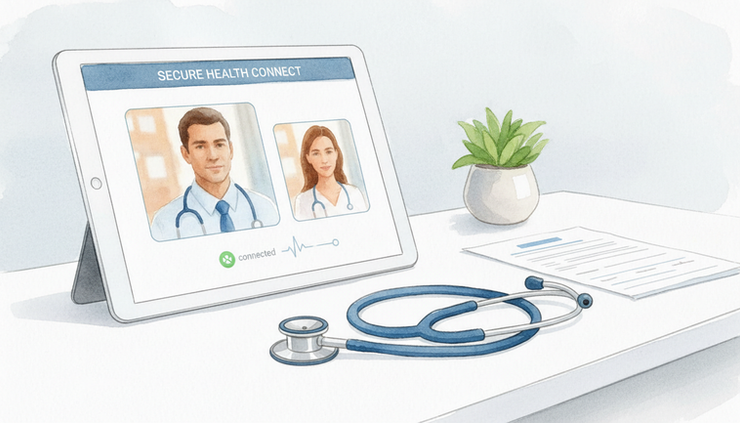
Secure telehealth protects privacy before, during, and after the visit
Patient privacy is not a single moment. It begins when the appointment is scheduled and continues after the visit ends.
A secure telehealth process protects information at each step.
Before the visit
A strong process starts with the basics. The patient receives clear instructions, uses a secure link, and understands where to join from. Staff confirm contact information and explain what to do if the connection fails.
Providers should also think about the patient’s physical space. A patient in a crowded home, shared shelter, workplace break room, or parked car may not have privacy. That does not always mean telehealth should be canceled. It means clinicians should ask simple questions:
Are you somewhere you can talk privately?
Is anyone else in the room?
Would you prefer yes-or-no questions for part of the visit?
Should we switch to another time or communication method?
These questions are especially important for behavioral health, reproductive health, domestic violence concerns, substance use treatment, and adolescent care.
During the visit
The platform should help control who enters the session. Waiting rooms, meeting locks, and participant controls reduce the risk that the wrong person joins.
Clinicians also need a reliable way to confirm the patient’s identity. That may involve asking for name and date of birth, confirming location in case emergency help is needed, and checking that the patient understands the limits of remote care.
For some visits, the clinician may also need consent for telehealth. Rules can vary by state, payer, specialty, and service type. The platform should make it easier to record consent when required.
After the visit
The privacy work continues after the screen turns off. Visit notes, prescriptions, follow-up messages, forms, and referrals must be handled securely.
A weak process might leave files in personal email, unprotected downloads, or unsecured devices. A better process keeps communications inside approved systems and limits copies of sensitive information.
Audit logs also matter after the visit. If a patient asks who accessed their information, or if the organization investigates a concern, the platform should provide a record.
Patients are not the only ones who benefit
Telehealth gets framed as a patient convenience, but the benefits are broader when the service is secure and thoughtfully used.
Patients with travel barriers
Patients in rural communities, patients without reliable transportation, older adults who no longer drive, and people with mobility challenges may delay care when every visit requires travel. A video visit can remove one barrier, especially for follow-up care.
The Federal Communications Commission has long recognized broadband access as a healthcare issue in rural areas. Remote care cannot solve every access problem, especially where internet service is limited, but it can help when connectivity is available.
People managing chronic conditions
Diabetes, high blood pressure, asthma, heart conditions, and other long-term needs require ongoing contact. Not every check-in needs a physical exam. Medication reviews, symptom updates, education, and care planning can often happen remotely when clinically appropriate.
That can help providers spot problems earlier. A patient who might skip an in-person follow-up may be able to attend a short virtual visit.
Behavioral health patients
Behavioral health services are one of the clearest use cases for telehealth. Talk-based care often translates well to video when privacy, safety planning, and licensing requirements are addressed.
Research and public health guidance have recognized telehealth as a way to improve access to mental health care, especially when provider shortages or travel barriers exist. It should not replace every in-person service, but it can reduce missed care for many patients.
Caregivers and family support
Some visits involve caregivers, guardians, interpreters, or family members. A secure platform can help include the right support person without requiring everyone to travel to the same location.
This is useful for pediatric care, elder care, disability support, and complex care planning.
Healthcare staff and organizations
Healthcare teams benefit when telehealth reduces avoidable gaps in care. It can help fill appropriate appointment types, reduce late cancellations caused by transportation problems, and support care plans between in-person visits.
The key is fit. Telehealth is not ideal for every complaint, every patient, or every specialty. Secure platforms work best when organizations choose the right visit types and train staff on the process.

Providers should consider telehealth before access problems become emergencies
The best time to plan telehealth is before a crisis. Many organizations waited until outside pressure forced fast adoption. That can work in the short term, but rushed setups often create privacy gaps, staff confusion, and uneven patient experiences.
Healthcare providers should consider implementing telehealth when any of the following patterns appear.
Patients miss visits because getting there is hard
Transportation issues, distance, weather, caregiver duties, work schedules, and mobility limits all affect access. If missed appointments often trace back to travel, telehealth may help for selected visit types.
Follow-up care is slipping
Post-discharge check-ins, medication changes, lab result reviews, and chronic care follow-ups often lose momentum when patients must wait weeks for an in-person slot. A secure remote visit can keep care moving.
Behavioral health demand is outpacing access
Many areas face shortages in mental health services. Telehealth can expand appointment options when licensing, privacy, emergency planning, and clinical appropriateness are addressed.
Patients ask for virtual options
Patient demand alone should not drive the decision, but it is a signal. If patients regularly ask whether a visit can happen remotely, the organization should decide which services are safe to offer that way.
Public health, weather, or local disruptions affect care
Storms, infectious disease outbreaks, poor air quality days, and local emergencies can interrupt routine visits. A prepared telehealth option gives providers a backup care pathway.
Specialists need to support distant patients
Specialty care often requires long travel. Telemedicine can help with consults, second opinions, follow-ups, and care coordination when an in-person exam is not required.
Search terms vary. Some people call it HIPAA compliant telemedicine, others call it HIPAA compliant telehealth, telemedicine, virtual healthcare, or simply telehealth. The practical question is the same: can the service protect patient information while supporting appropriate care?
A reliable platform should fit the organization, not just the appointment
Choosing a platform should start with the type of care being delivered. A solo therapist, a pediatric practice, a specialty group, a rural health clinic, and a home health agency may all need different workflows.
The platform should answer several plain-language questions.
Can the vendor sign a business associate agreement?
Does the platform encrypt video, messages, and stored information?
Can staff use different permission levels?
Does the system keep audit logs?
Can patients join without exposing private information to the wrong person?
Can the platform support consent documentation?
Does it work on common patient devices?
Can the organization control recordings, downloads, and file sharing?
Does the vendor explain how it handles security incidents?
Does the platform support the languages and accessibility needs of the patient population?
The last point deserves more attention. A secure platform that patients cannot use will fail in practice. Accessibility features, interpreter support, clear instructions, and a simple patient experience all affect real-world privacy. If a patient needs a family member to manage every login screen, privacy may suffer.
Security and usability should be reviewed together.
Internal policies matter as much as the software
Even a strong platform can be used badly. A clinician could hold a visit in a public place. A staff member could send a link to the wrong address. An organization could allow shared passwords. A provider could record visits without a clear policy.
HIPAA compliance depends on people and process, not just tools.
At a minimum, healthcare organizations should create simple written policies for:
Which visit types are allowed by telehealth
How patient identity is confirmed
How consent is handled
Where clinicians may conduct visits
What to do if someone else is in the room
How emergency situations are managed
Whether visits may be recorded
How messages and files are stored
How staff report privacy or security concerns
How new users receive training
Training should use real examples. A policy that says “protect patient privacy” is too vague. A better training example says, “Do not conduct a video visit from a coffee shop, even with headphones, because people nearby may hear health details.”
Plain examples help staff make better decisions under pressure.
Resources for finding reliable HIPAA compliant platforms
No single public list can guarantee that a platform is right for every provider. HIPAA compliance depends on the vendor, the contract, the setup, and the healthcare organization’s own practices. Still, reliable resources can guide the search.
Federal HIPAA guidance
The U.S. Department of Health and Human Services offers HIPAA guidance through its Office for Civil Rights. Providers can review materials on the Privacy Rule, Security Rule, breach notification, and business associates.
This is the best starting point for understanding the legal framework. It will not choose a vendor, but it helps organizations ask better questions.
State licensing boards and health departments
Telehealth rules can vary by state. Providers should check state licensing board guidance for consent, prescribing, patient location, recordkeeping, and professional standards.
This is especially important for clinicians who see patients across state lines.
Professional associations
Medical, nursing, behavioral health, therapy, and specialty associations often publish telehealth guidance for their fields. These resources can help providers match platform features to clinical standards.
For example, a behavioral health practice may need different safety planning workflows than a dermatology group reviewing images.
Compliance consultants and healthcare attorneys
A consultant or attorney with healthcare privacy experience can review vendor contracts, business associate agreements, workflows, and policies. This is useful when the organization lacks in-house compliance staff.
Peer references without brand shortcuts
Other providers can share practical lessons about reliability, patient ease of use, support, and implementation problems. That said, a peer recommendation is not enough. A platform that works for one specialty may not fit another.
Ask about the process, not just the product:
How hard was staff training?
Did patients struggle to connect?
Were access controls easy to manage?
How did the vendor handle questions about security?
Did the platform support documentation needs?
Vendor documentation
Before signing, request clear documentation on privacy, security, business associate agreements, data storage, incident reporting, user access, and audit logs. If the answers are vague, slow, or inconsistent, that is a warning sign.
A trustworthy vendor should be able to explain how it protects health information in plain language.
A practical evaluation checklist
Before adopting a platform, healthcare leaders can use a simple review process.
Identify the care use cases.
List the visit types that make sense for remote care. Separate follow-ups from urgent evaluations, complex exams, and services that require in-person testing.
Map the patient journey.
Follow the patient from scheduling to post-visit instructions. Look for privacy gaps at every step.
Review the vendor’s privacy and security materials.
Confirm encryption, access controls, audit logs, data practices, and business associate agreement terms.
Test the platform with real workflows.
Run mock visits. Include scheduling staff, clinicians, patients, interpreters, and caregivers if those roles are common.
Train staff before launch.
Cover both the technology and privacy behavior. Include examples of what not to do.
Recheck after launch.
Review patient feedback, missed visits, staff questions, and any privacy concerns. Telehealth should improve over time.
FAQ
Does using a HIPAA compliant platform make a provider fully HIPAA compliant?
No. The platform is only one part of compliance. Providers also need proper policies, staff training, risk review, access controls, secure documentation, and signed business associate agreements when required.
Can healthcare providers use regular video chat tools for patient visits?
For regulated healthcare services, providers should be careful. A tool that works for casual calls may not offer the safeguards, agreements, access controls, and documentation support needed for HIPAA-covered care.
Is telehealth safe for all medical visits?
No. Some visits require a physical exam, imaging, testing, or emergency care. Telehealth works best when the visit type is clinically appropriate and when the provider has a plan for urgent concerns.
What should patients look for in a secure telehealth visit?
Patients should receive a secure link, clear instructions, privacy guidance, and information about who will join the visit. They should also feel comfortable asking how their information is protected.
How often should providers review their telehealth setup?
Providers should review it at least when workflows change, staff roles change, vendors update terms, new services are added, or a privacy concern occurs. Many organizations also review privacy and security practices on a regular schedule.

Secure virtual care is now part of trustworthy care
Telehealth is no longer a temporary workaround or a convenience feature. It is part of how modern healthcare reaches patients, supports follow-up, and keeps care connected between in-person visits.
The organizations that win patient trust will not be the ones with the flashiest video tool. They will be the ones that make privacy visible in ordinary moments: the right link, the right participant, the right record, the right access, and the right follow-up.
For help reviewing secure virtual care options and compliance planning, visit MLJ Consultancy pricing plans.
A secure telehealth program does more than connect a screen. It protects the relationship at the center of healthcare: the patient trusting the provider with information that deserves care.


Comments