

Harnessing Generative AI in Healthcare to Improve Health Care Outcomes and Administrative Efficiency

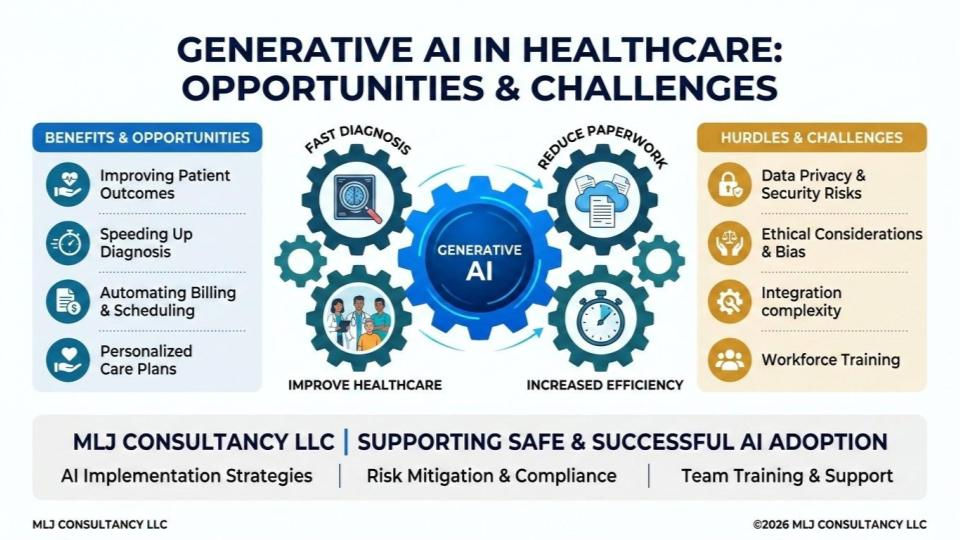
Generative AI offers new ways to improve health care, speed up diagnosis, and reduce the burden of paperwork. This technology creates opportunities to make healthcare more effective and efficient. At the same time, it brings challenges that providers must address carefully.
This post explores how generative AI is being used in healthcare today. It looks at the benefits, and the hurdles faced by medical teams. It also highlights how MLJ CONSULTANCY LLC supports healthcare organizations in adopting AI safely and successfully.
How Generative AI Improves Patient Outcomes
Generative AI can analyze large amounts of medical data quickly. This helps healthcare providers make better decisions and tailor treatments to individual patients. For example, AI models can predict how a patient might respond to a certain medication or identify risks before symptoms appear.
One clear benefit is personalized care. AI can generate treatment plans based on a patient’s unique health profile. This reduces trial and error and leads to faster recovery. It also helps in managing chronic diseases by continuously monitoring patient data and suggesting adjustments.
Another advantage is early detection. AI tools can spot subtle patterns in medical images or lab results that humans might miss. This leads to earlier diagnosis of conditions like cancer or heart disease, improving chances of successful treatment.
Enhancing Diagnostics with Generative AI
Diagnostics is a key area where generative AI shows promise. AI systems can generate detailed reports from medical scans, lab tests, and patient histories. This supports radiologists, pathologists, and other specialists by providing a second opinion or highlighting areas of concern.
For example, AI algorithms have been used to analyze X-rays and MRIs to detect tumors or fractures with high accuracy. These tools reduce the time needed to review images and help avoid diagnostic errors.
Generative AI also assists in creating synthetic medical data for training purposes. This helps improve AI models without risking patient privacy. It allows healthcare providers to test new diagnostic tools in a safe environment before applying them in real cases.
Streamlining Administrative Tasks
Healthcare providers spend a lot of time on paperwork, billing, and scheduling. Generative AI can automate many of these tasks, freeing staff to focus more on patient care.
AI-powered systems can generate patient records, insurance claims, and appointment reminders automatically. They can also help with coding medical procedures for billing, reducing errors and speeding up reimbursements.
By handling routine tasks, AI reduces burnout among healthcare workers. It also improves accuracy and compliance with regulations like HIPAA, which protects patient privacy.
How MLJ CONSULTANCY LLC Supports AI Adoption in Healthcare
MLJ CONSULTANCY LLC plays a key role in helping healthcare organizations adopt AI technologies responsibly. Their services focus on strategic planning, HIPAA compliance, and practical implementation.
They offer Artificial Intelligence (AI) Consulting that guides providers on using AI while staying fully HIPAA-compliant. This ensures patient data is protected throughout AI projects. Learn more about this service here.
For organizations ready to implement AI, MLJ CONSULTANCY LLC provides an AI Healthcare Implementation Strategy. This service accelerates AI adoption by focusing on improving patient outcomes and operational efficiency, all within HIPAA rules. More details are available here.
Their Healthcare AI Implementation Consulting offers hands-on support for integrating AI tools into daily workflows. This includes strategic planning, HIPAA compliance checks, and training staff to use AI effectively. Find out more here.
By working with MLJ CONSULTANCY LLC, healthcare providers can navigate the complexities of AI adoption with confidence. Their expertise helps avoid common pitfalls and ensures AI delivers real value.
Challenges Healthcare Providers Face with Generative AI
While AI offers many benefits, healthcare providers face several challenges:
Data Privacy and Security: Protecting patient information is critical. AI systems must comply with strict regulations like HIPAA. Any breach can harm patients and damage trust.
Integration with Existing Systems: Many healthcare facilities use legacy software. Integrating AI tools smoothly requires careful planning and technical expertise.
Staff Training and Acceptance: Clinicians and staff need training to use AI tools effectively. Some may be skeptical or concerned about AI replacing human judgment.
Bias and Accuracy: AI models can reflect biases in training data. This can lead to unfair or incorrect outcomes. Continuous monitoring and updating of AI systems are necessary.
Cost and Resources: Implementing AI can require significant investment. Smaller providers may struggle to afford the technology and expertise needed.
Moving Forward with Generative AI in Healthcare
Generative AI has the potential to transform healthcare by improving patient outcomes, enhancing diagnostics, and reducing administrative burdens.
Healthcare organizations should approach AI adoption with a clear strategy. This includes ensuring compliance with privacy laws, training staff, and choosing the right AI tools for their needs.
Partnering with experts like MLJ CONSULTANCY LLC can make this process smoother. Their consulting services help healthcare providers build AI solutions that are safe, effective, and aligned with their goals.
As AI technology continues to evolve, it will become an even more valuable part of healthcare. Providers who embrace it carefully will be better positioned to deliver high-quality care and improve patient experiences.


Comments