

De-identification vs Anonymization in AI Projects Key Differences, Risks, and Compliance

A single data point rarely looks dangerous on its own. A birth year, ZIP code, voice sample, purchase history, or hospital visit date may seem harmless. Put enough of those points together, though, and a person can become recognizable.
That is why privacy work matters before a model ever sees the data.
In artificial intelligence projects, teams often need large, detailed data sets. Those data sets may include health records, customer support messages, images, location patterns, financial activity, or sensor readings. The more realistic the data, the more useful it can be. The more personal the data, the more care it needs.
Two practices come up often: de-identification and anonymization. People sometimes use the terms as if they mean the same thing. They do not. The difference can affect model quality, privacy risk, legal duties, data sharing, and public trust.
This article explains de-identification and anonymization in the context of AI projects in plain language, with practical examples, benefits, risks, and compliance considerations. This is informational only and not legal advice.

What de-identification means in AI projects
De-identification means changing data so it no longer directly identifies a person, or so identifying someone becomes harder.
Common direct identifiers include:
Full name
Social Security number
Email address
Phone number
Home address
Account number
Clear face image
Medical record number
A team may remove those fields, replace them with random codes, blur faces, shorten dates, or group ages into ranges. The goal is to reduce the chance that a person can be identified from the data.
De-identification does not always make data anonymous. In many cases, someone with access to extra information could still reconnect the data to a real person.
For example, imagine a health data set used to train a model that predicts hospital readmission risk. The data team removes names, phone numbers, and record numbers. Each patient gets a random study code, such as `Patient 18427`. The model can still learn from age, diagnosis, medication history, and previous visits.
That data is de-identified. It is safer than raw health records, but it may still carry privacy risk. If a rare diagnosis appears with a specific age, ZIP code, and admission date, someone might infer who the person is.
Common de-identification methods
Several methods can reduce identifiability while keeping data useful.
Method | What it does | Example in an AI project |
Removal | Deletes direct identifiers | Removing names and phone numbers from customer messages before training a support model |
Masking | Hides part of a value | Showing only the year of birth instead of the full date of birth |
Generalization | Makes details less specific | Replacing exact age with age range, such as 40 to 49 |
Random replacement | Swaps identifiers for random codes | Replacing patient names with study numbers |
Suppression | Removes unusual or high-risk values | Removing extremely rare job titles from a hiring data set |
Blurring | Reduces visible identity in images or video | Blurring faces and license plates in street images |
These methods can be used together. A safer data set often comes from layers of protection, not one simple change.
What anonymization means in AI projects
Anonymization means changing data so people are no longer reasonably identifiable, even when the data is combined with other available information.
That standard is harder to meet.
Anonymized data should not allow the original person to be singled out, linked across records, or inferred with meaningful confidence. If someone can reverse the process, or if the data can be tied back to a person through a separate key, it is usually not truly anonymous.
For example, a research group may want to study traffic patterns for an urban planning model. Instead of keeping individual GPS trails, the group aggregates trips into broad road segments and time windows. It reports that 3,000 trips passed through a corridor between 7:00 a.m. and 9:00 a.m., not that one phone traveled from a specific home to a specific workplace.
That is closer to anonymization because the individual path is no longer present.
Common anonymization methods
Anonymization often uses stronger transformations than de-identification.
Method | What it does | Example in an AI project |
Aggregation | Combines many people into a group | Training a traffic model on counts by road segment instead of individual routes |
Noise addition | Adds controlled random variation | Slightly changing counts in a data release so one person cannot be inferred |
Data synthesis | Creates artificial records that resemble real patterns | Generating fake transaction histories for model testing |
Coarsening | Reduces precision across the data set | Using county-level location instead of exact coordinates |
Record removal | Deletes records that are too unique | Excluding rare combinations that could identify one person |
Anonymization protects people by reducing detail. The tradeoff is that the data may become less useful for certain model tasks, especially when rare events matter.
The key differences between de-identification and anonymization
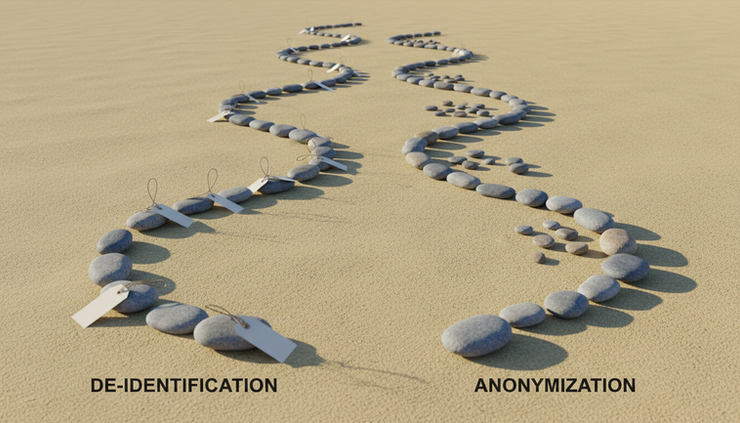
The simplest distinction is this: de-identification reduces identity risk, while anonymization aims to remove identity risk to a reasonable standard.
That difference affects how teams store data, share it, audit it, and explain it to regulators or customers.
Question | De-identification | Anonymization |
Can the data still relate to a person? | Often yes, especially if a separate key exists | It should not reasonably relate to a person |
Can re-identification happen? | Possible in some cases | Should be highly unlikely |
Does the data remain useful for detailed modeling? | Usually yes | Sometimes, depending on the task |
Is it usually still covered by privacy rules? | Often yes | Sometimes no, if truly anonymous under the law |
Is it reversible? | It may be reversible by authorized people | It should not be reversible |
Main privacy value | Reduces exposure | Removes or greatly lowers personal identity risk |
Main practical tradeoff | Needs controls and ongoing risk checks | May reduce detail and model performance |
A useful way to think about it is a locked room versus removing the room entirely.
De-identification often keeps the detailed data but hides or replaces identity markers. Access controls, policies, contracts, and security still matter. Anonymization changes the data so the person is no longer present in a meaningful way.

Why the difference matters for privacy and compliance
Privacy laws often focus on whether data can identify a person. That makes the distinction between de-identified and anonymized data more than a wording issue.
In the United States, health data may fall under the Health Insurance Portability and Accountability Act, commonly called HIPAA. The law includes standards for de-identifying protected health information. One path removes a list of specific identifiers. Another relies on expert judgment that the risk of identifying someone is very small.
In the European Union, the General Data Protection Regulation treats anonymous data differently from personal data. But it also sets a high bar. If a person can still be identified using reasonable means, the data may still count as personal data. While this article uses US spelling and examples, many AI projects operate across borders, so teams often need to account for both US and international rules.
Several US state privacy laws also focus on personal information, de-identified data, and reasonable safeguards. The exact language varies by state, but the pattern is clear: a team should be able to explain what it changed, why the remaining risk is acceptable, and how it prevents misuse.
Compliance is not just a checkbox
A model can create privacy risk even if the source data was cleaned.
For example, a model trained on detailed personal data might reveal sensitive patterns through its outputs. If a text model memorizes rare phrases from private records, it could repeat them later. If a prediction model responds differently to very specific combinations of traits, someone may infer that a person was in the training data.
That is why privacy work should cover the full data life cycle:
Collection
Labeling
Cleaning
Training
Testing
Deployment
Monitoring
Retention and deletion
De-identification and anonymization help most when they sit inside a wider privacy program. Access limits, logging, staff training, security reviews, and data retention rules all matter.
Real-world examples of de-identification in AI
De-identification is common when teams need detailed records but do not need obvious identity fields.
Health prediction models
Hospitals and research groups often train models on medical history, lab results, medications, and outcomes. Names and direct contact details may be removed. Dates may be shifted. Patient numbers may be replaced with study codes.
This keeps the data useful for tasks such as predicting readmission risk or spotting possible complications. The model needs clinical patterns, not names.
The risk is that health data can be highly unique. A person with a rare condition in a small town may be recognizable even without a name. That is why health projects often combine de-identification with access limits and ethics review.
Customer support models
A company may use past support messages to train a tool that suggests answers to common questions. Before training, the team can remove names, emails, account numbers, addresses, and payment details from the text.
This lowers the chance that the model memorizes personal information. It also reduces the amount of sensitive data handled by staff and systems.
The challenge is that people may type personal facts into open text fields in unexpected ways. A rule that removes email addresses may miss a passport number, medical detail, or family name. Text data needs careful review and testing.
Voice and speech systems
Speech models may use recordings to improve transcription or call routing. De-identification can remove account numbers from transcripts, cut sections where callers state personal details, or alter stored speaker labels.
Voice is harder because the sound itself can identify someone. Even if the transcript is clean, a raw recording may reveal the speaker. In many cases, teams need stronger controls or different consent terms for audio.
Image and video models
AI models used for safety, mobility, or accessibility may rely on images and video. De-identification can blur faces, license plates, house numbers, or other identifying features before training.
This method can work well when the identity of a person or vehicle is not needed. For example, a model that detects crosswalks does not need visible faces.
The tradeoff is model accuracy. If the model must detect facial expressions for a valid and lawful use, blurring faces could defeat the task. That does not mean privacy should be ignored. It means the team needs a different design, a clear legal basis, and stronger protection.
Real-world examples of anonymization in AI
Anonymization is used when teams want patterns without keeping personal-level records.
Traffic and mobility planning
A city or research team may use traffic counts, travel time ranges, and grouped trip flows to train a model that predicts congestion. Instead of storing individual routes, it keeps totals by zone and time period.
This supports planning without tracking specific drivers or pedestrians. It also reduces the chance that home and work locations can be linked to a person.
Small groups remain a risk. If only one person travels between two remote areas at a certain hour, even aggregated data may reveal too much. Good anonymization often requires minimum group sizes before data is shared.
Retail demand forecasting
A retailer can train demand forecasting models using store-level sales totals instead of customer-level purchase histories. The model learns that certain items sell more by season, region, or time of day.
This can be anonymous if the data no longer shows individual buying behavior. It may not support personalized recommendations, but it can support inventory planning with much lower privacy risk.
Synthetic training data
Synthetic data is artificial data created to resemble real data patterns. For example, a team may generate fake loan applications, fake appointment schedules, or fake support tickets to test a model workflow.
Synthetic data can reduce privacy risk because records do not belong to real people. It is not automatically anonymous, though. If the synthetic data copies rare real records too closely, it can still leak personal information. Teams need tests that check whether synthetic records are too similar to original records.
Public research releases
Researchers sometimes publish aggregated data so others can test methods or repeat findings. Instead of releasing raw records, they may share summary tables with broad categories.
This can improve transparency while protecting participants. The balance is delicate. Data that is too broad may not support meaningful research. Data that is too detailed may expose people.

Benefits and risks of de-identification
De-identification is practical because it keeps much of the value of the original data. It can let teams build and test models without exposing direct identifiers.
Main benefits
It supports useful model training.
Many machine learning tasks need detailed examples. De-identification can preserve the details that matter while removing direct identity markers.
It reduces harm from data exposure.
If a data file is misdirected or accessed by the wrong person, removing direct identifiers can lower the damage.
It supports least-use privacy practices.
A team may not need names, emails, or exact addresses to train a model. Removing them follows the principle of using only what is needed.
It can help meet legal and contractual duties.
Some laws, contracts, and data sharing agreements expect de-identification before data is used for research, development, or testing.
Main risks
People can sometimes be re-identified.
A classic privacy lesson is that combinations of details can identify people. Birth date, gender, and ZIP code can be revealing when combined with other data. Modern data sources make linking easier.
Hidden identifiers can remain.
Free text, images, audio, device data, and timestamps may carry clues that are easy to miss.
A re-identification key can become a target.
If a table maps random study codes back to real people, that table needs strong protection. If it leaks, the de-identified data may become identifiable again.
Models can memorize rare data.
Some models can repeat unusual training examples, especially when trained on small or highly specific data sets. De-identifying inputs helps, but it does not remove all output risk.
Benefits and risks of anonymization
Anonymization offers stronger privacy protection when done well. It can also make data easier to share because it no longer centers on identifiable people.
Main benefits
It lowers privacy risk more deeply.
If data no longer points to real people, a breach or misuse is less likely to harm individuals.
It can simplify some compliance duties.
Some privacy laws do not apply to truly anonymous data. The key word is truly. If identification remains reasonably possible, the data may still be regulated.
It supports safer data sharing.
Aggregated or synthetic data can help researchers, vendors, auditors, and public agencies work with patterns instead of personal records.
It builds trust.
People are more likely to trust data projects when they see that personal identity is not being kept unless needed.
Main risks
The data may lose useful detail.
Anonymization can remove rare events, exact times, detailed geography, or individual sequences. That may weaken a model.
False anonymity is dangerous.
Calling data anonymous does not make it anonymous. If a person can still be singled out, linked, or inferred, the label creates a false sense of safety.
Small groups can expose people.
Aggregated data can reveal sensitive facts when groups are too small. For example, if a table shows one person in a category, the summary may expose that person.
Synthetic data can leak patterns.
Artificial records can still reveal real people if the generation process repeats rare source records.
How to choose the right approach
The right method depends on the purpose, the data, and the risk. De-identification and anonymization are not rivals. They solve different problems.
Use de-identification when the project needs record-level detail and there is a valid reason to keep it. Use anonymization when the project can work with group patterns, synthetic records, or reduced detail.
A basic decision process can help.
Start with the model task
Ask what the model truly needs.
A readmission model may need sequence, timing, and clinical detail. A hospital staffing forecast may only need daily counts by department. Those are different privacy cases.
If a model can learn from aggregated data, anonymization may be the better choice. If it needs individual histories, de-identification may be more realistic.
Map the identity clues
Look beyond obvious fields. Identity can appear in:
Timestamps
Locations
Rare diagnoses
Unusual job titles
Photos
Voice recordings
Free text
Device identifiers
Small group categories
A simple name-removal step is rarely enough for complex training data.
Measure re-identification risk
Teams should test whether a person could be singled out or linked to outside facts. This does not require public guessing games with real people. It can be done through controlled privacy review.
Useful questions include:
How many records are unique?
Are group sizes large enough?
Could outside data link to these records?
Does the model expose training examples?
Who can access the original data and any keys?
Keep records of decisions
Compliance often depends on evidence. A team should document what data it used, what it removed, what method it applied, who approved it, and what risks remain.
Good records help later when auditors, partners, regulators, or internal reviewers ask why the data was handled a certain way.
Review after deployment
Privacy risk can change. New data sources appear. Models get updated. Staff roles change. A data set that seemed low risk last year may become easier to link today.
Periodic review helps keep privacy claims accurate.
A simple comparison for project planning
The table below can guide early planning. It should not replace legal or privacy review, but it can help teams ask better questions.
Project need | Better starting point | Why |
Train on detailed patient journeys | De-identification | The model may need record-level history |
Share traffic trends with public researchers | Anonymization | Group counts may be enough |
Test a data pipeline without real records | Anonymization through synthetic data | Fake records can reduce exposure |
Improve support replies from message history | De-identification | Text can be cleaned while keeping language patterns |
Publish research findings | Anonymization | Summary data can reduce participant risk |
Build personalized services | De-identification with strict controls | Individual-level data may be needed, but it remains sensitive |
The main lesson is simple: do not choose the easier label. Choose the method that matches the use case and the real risk.
Practical safeguards for both approaches
Both methods work better when paired with broader safeguards. Privacy is not only a data transformation problem.
Use these practices where they fit:
Limit access to people who need the data for a defined task.
Remove raw data as early as possible.
Store any re-identification key separately from de-identified records.
Set retention periods so data does not stay around forever.
Test models for memorization or leakage before release.
Review free text, images, and audio carefully.
Use contracts that ban re-identification attempts when sharing data.
Keep audit logs that show who accessed sensitive data.
Train staff on what de-identified and anonymized data really mean.
The phrase "anonymous data" should be used with care. If the statement cannot be defended with evidence, it can create legal, ethical, and trust problems.
Teams that need help deciding which privacy approach fits a project can review available support here: compare consulting options for AI data privacy planning.
FAQ
Is de-identified data still personal data?
Often, yes. If the data can still be linked back to a person, directly or indirectly, many privacy rules may still treat it as personal data. The answer depends on the law, the data, and the remaining risk.
Is anonymized data always safe to share?
No. Anonymized data is safer only if the anonymization is strong enough. Small groups, rare details, and outside data sources can make people identifiable again.
Can a model trained on de-identified data reveal private information?
Yes, in some cases. Models can memorize unusual examples or reveal patterns that expose membership in a data set. Testing and output controls help reduce that risk.
Is synthetic data the same as anonymized data?
Not always. Synthetic data can be anonymous if it does not copy real people too closely. If it repeats rare records or preserves identifying patterns, it can still create privacy risk.
Which method is better for compliance?
Neither is automatically better. De-identification may be right when detailed data is needed and controls are strong. Anonymization may be better when group patterns are enough. The method should match the project purpose and the legal standard.
The takeaway
De-identification and anonymization both help protect privacy in AI development, but they are not interchangeable.
De-identification reduces identity risk while keeping data useful for detailed modeling. Anonymization goes further by aiming to remove reasonable links to real people. That stronger protection can support safer sharing and simpler compliance, but it may also reduce detail.
The best choice starts with the task. If a model needs individual-level patterns, de-identification with strong controls may be the practical route. If the model can learn from group trends, synthetic records, or broad summaries, anonymization can reduce risk more deeply.
The safest projects do not rely on labels. They use evidence, documented decisions, regular testing, and plain-language honesty about what the data can still reveal.


Comments